


As we step into 2026, our team remains focused on providing insight and clarity amid an evolving market and policy landscape. In this quarter’s edition of The Inside Scoop, we’re sharing key upcoming dates to keep on your radar, our 2026 market and policy outlook, and Baird’s recent Bull & Baird article exploring the forces driving the U.S. stock market. You’ll also find a collection of planning strategies and team updates curated to help you stay informed and prepared for the year ahead.
Yaz, Justin, Karley, Ashley & Whitney
.

Register to experience a family‑friendly weekend of bull riding, barrel racing, and more — while your ticket supports the Community Foundation of Rutherford County’s mission to strengthen local nonprofits right here at home. Our office proudly sponsors this event and we would love for you and your family to join us. Register: CFRC Rodeo Tickets
Join the community 15K/10K/5K/Family Fun Run—every registration helps provide Christ‑centered pediatric therapy and skilled nursing for children with special needs in Murfreesboro. Our office is a proud sponsor of this race and we would love for you and your family to join us. Register: Special Kids Race
.
.
BULL & BAIRD : What Moves the U.S. Stock Market?
Headline from January 3, 2026: US forces seize Venezuelan leader Maduro
Market reaction since the event: +1.5% (as of Jan 7, 2026)
You’d think that a secret U.S. operation to detain a foreign leader in the middle of the night and fly him to New York to face federal charges would spark volatility in the stock market, right?
Nope. In fact, we’ve started the year by hitting new all-time highs.
So, you might be wondering: What does move the U.S. stock market? What does it care about if not headline-grabbing global events like we just witnessed? Allow me to simplify it for you.
There are four major forces that drive stock market movement on a day-to-day basis (this is not intended to be an exhaustive list).
Earnings – What are companies saying about their profits, their forward outlooks, and the current state of their business?
Interest rates – Are interest rates going up or down? Will the Federal Reserve cut rates or hike them at their next meeting? Rates affect everything in the economy.
Flows – Are people moving money in and out of the stock market in such a way that it affects prices?
Investor Sentiment – How do people feel about their jobs, their homes, and their prospects for future economic security?
Now ask yourself: Does the event I’m watching on TV or reading about in the news affect those four things in a meaningful way?
Often, the answer is no.
Let me give you a few examples of major global shocks and how the market acted one month later:

A table showing a list of six big geopolitical disruptions of the last century, and how the market responded to each.
Notice which events caused declines in US stock prices. It was the ones that affected all four of the forces I mentioned—earnings, interest rates, flows, and investor sentiment—all at once.
How about the Cuban Missile Crisis? Surely that affected sentiment or flows? It did, but it was resolved so quickly that the impact was minimal.
The best way I’ve seen day-to-day stock market movement explained is this simple question: “Are things getting better, worse, or staying the same for the U.S. economy and the companies inside it?”
Remember the massive tariff-related selloff in April of 2025? The market thought to itself “If this happens, things will get worse for U.S. companies and consumers.” Then, the massive tariff levels were backed off and stocks rallied.
Better…worse…same?
Better…worse…same?
That’s all the market is thinking about every second of the day.
Could there be longer-term consequences for our actions in Venezuela? Like, say, the price of oil or global perceptions of the U.S.? Sure, but the market will deal with them as they come.
When global headlines scare you, I want you to remember that history is full of chaotic events. It’s always been like this. History is just one darn thing after another.
What can you do about that? Talk to your Baird Financial Advisor, stick to your plan, keep your friends and family close, live your life. That’s the way forward.
.

Part 1: Market & Policy
In the first part of Baird’s 2026 Outlook Series, Nicholas Bohnsack, President and Head of Portfolio Strategy at Strategas, a Baird company, talks through the firm’s outlook for 2026, highlighting emerging opportunities and signs of strength amid shifting market dynamics.
.
Part 2: Planning
While every year presents new opportunities and challenges, 2026 presents a host of changes that have significant implications for planning. Tim Steffen, Director of Advanced Planning, andHeather Osborn, Director of Wealth Planning, return for part two of Baird’s 2026 Outlook series to share the most notable changes as well as the annual steps to take to make the most of the year ahead.
.
.

 .
.
.
Our team exists to come alongside you in your wealth journey as we do not believe in a one sized fits all approach when it comes to your future. In order for us to serve you to the best of our ability, we ask that you keep a few things updated along the way.
Taxes
After filing, send us your tax return. Every year. It's that easy. Our team will then do a thorough analysis.
We will discuss implications and scenario-based decisions personalized to you and your family.
Tax Planning Perspective VIDEO
Estate Documents
It is imperative that you update us when there are material changes to your will, power of attorney, and other directives. No one wants to think about the worst-case scenario, however, keeping our team informed of any updates ensures a smooth transition if/when it was to happen.
Estate Planning Perspectives VIDEO
Insurance
Start the conversation and keep us updated on your current plan.
Whether it be a whole life policy review, health or property insurance referrals, we will review your current situation and connect you with the best resource to mitigate risk.
360 Wealth
Log in to the Baird Online app. At a minimum, link the basics. (mortgage, 401(k), loans and bank accounts).
Your accounts will auto-update and will feed into your financial plan for a 360 view & precise financial advice. It is important to keep us informed of any outside accounts as we periodically review your long-term goals.

We share our lives with you because you are an extension of our family. Long-term relationships which encourage open and honest communication have been the cornerstone of our team's success for many years. Thank you for allowing us to walk alongside you and your family.


.
.
.

2025 ended with a great deal of economic uncertainty, due in part to the government shutdown, tariff ambiguity and the lag between passage of last year’s tax legislation (mid-2025) and when its tax refunds and incentives will take effect (2026 and on). These factors have created concerns around hiring and business investment, but we expect conditions to improve as the bill’s tax incentives gain traction. Our view is that fiscal stimulus paired with easier monetary policy should help keep the economy out of recession in the near term.
While stocks remain expensive, strong profits help justify those high valuations. We anticipate +9% S&P 500 earnings growth in 2026 – it is tough to see the economy getting into too much trouble with earnings growing at roughly twice the pace of GDP. We also expectour investment themes from last year– artificial intelligence, an industrial power renaissance, companies with steady cash flows, and deglobalization – to remain relevant. And for 2026, we’re adding a fifth: beneficiaries of a stimulus-driven consumer spending wave.
In terms of asset allocation, we see opportunity shifting away from U.S. Large-Cap Growth and toward the industrial power players in U.S. Large- and Mid-Cap Value. Among U.S. equity sectors, we favor Financials, Industrials, Utilities and Consumer Discretionary. In a period of heightened uncertainty, deglobalization and a weaker dollar, gold and other alternative assets will likely serve as both core holdings and transition assets.
Washington Policy
We anticipate nearly $300 billion in tax cuts for consumers and businesses in 2026 – at a time when the Federal Reserve is already cutting rates. This one-two punch of fiscal and monetary policy should offset the negative impact of tariffs, though there is potential for higher volatility until consumer stimulus hits the economy around tax season. When this tailwind does arrive, we believe U.S. growth will accelerate into the back half of the year.
Stimulus in the form of more than $500 billion in tax refunds could spur economic growth in the second half of the year.
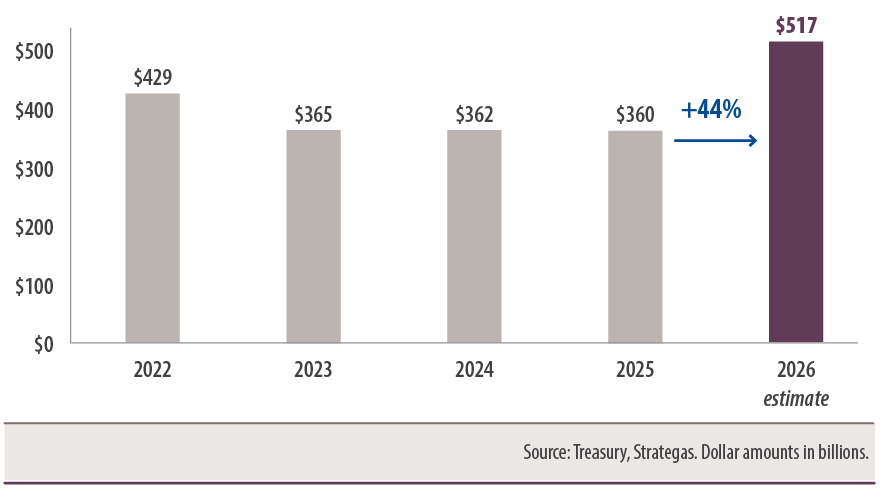
The timing of that tailwind could even be positive: Midterm election years tend to be more challenging for the S&P 500, with an average intra-year decline of 19%. These selloffs, however, have proven to be great buying opportunities – the index has not declined in the 12 months following a midterm election since 1942.
The U.S. Economy
Inflation and higher interest rates have weighed on housing and manufacturing in recent years, and 2025’s tariff shock and government shutdown put additional pressure on economic activity. However, supply chain issues have remained manageable, and U.S. rents remain in a slowing trend. While the bout of inflation that started in 2022 appears to be over, history tells us that a second wave is possible. Productivity gains, especially fromtechnology like AI (a topic addressed in this issue), could help keep prices in check.
Last year saw a reduction in interest rates, justified first by lower inflation and reinforced by a cooling labor market. The Fed will likely want to get monetary policy back to a neutral setting through additional rate cuts, though they don’t appear to be in a rush. Meanwhile, a growing U.S. budget deficit has the potential to crowd out other economic activity, and fixing this requires walking a fine line: Cutting the deficit too abruptly could stall the economy, but letting it run too hot could spark inflation if consumers lose confidence in prices remaining stable.
Taking all this into consideration, we are optimistic about the likelihood for growth in 2026: We place our odds at a 20% chance of recession, 60% chance of soft landing or expansion and a 20% chance of surprise to the upside. With strong earnings, policy support and clear investment themes, we believe 2026 offers significant opportunities for disciplined investors.
.
.

At Baird, we’re continuously exploring new investments in technology because we know they make a meaningful difference in how we support you. When it comes to enabling them – like AI – we do so with care, ensuring they strengthen the trust and relationships that have defined our firm for over a century. In the following article, we explore both sides of Baird’s approach to AI: how we’re thoughtfully integrating AI into advisor teams’ practices, and how we’re ensuring human connection endures.
So, how is Baird weaving AI into the way advisor teams work?
What It Takes for AI To Earn Its Place at Baird
Behind every new technology at Baird are processes and protocols designed to protect clients and preserve trust. The balance between cutting-edge innovation and authentic relationships is evaluated long before any tool reaches an advisor’s desk. Our experts must ensure every tool honors the integrity and human connection that define our wealth management services.
How Advisor Teams Can Use AI Today
With responsible practices guiding us, advisor teams can use AI to empower daily work. Financial Advisors and Client Specialists often use it as a tool to streamline tasks like preparing for meetings, managing routine responsibilities and capturing meeting notes. Simplifying these to-dos is game-changing for efficiency, allowing teams more time for what matters most: listening and strategizing with clients.
AI can also act as an initial reviewer for documents and processes. With human oversight, Baird’s tools can check forms for accuracy and summarize complex reports – helping your advisor analyze a broad range of information about your situation and uncover deeper insights and strategies. AI tools at Baird can also help flag unusual transactions that may indicate identity theft, adding another layer of protection.
By thoughtfully integrating AI, advisor teams are showing that technology can streamline processes, enhance service and expand what’s possible in wealth management. But as AI becomes more common, the true value of human advisors becomes even clearer.
In an increasingly digital world, where do Financial Advisors’ insights matter most?
AI Provides Information – Advisors Provide ContextAI has, in some ways, become the new search engine. What we once typed into Google, we now type into an AI digital assistant. Why? Because it synthesizes complex information into concise answers.
But convenience doesn’t always mean completeness. Ask AI how much to save for retirement, and it may suggest 15% of your income – unaware whether you’re caring for aging parents, planning to downsize or travel internationally every year.
Without the right context and input, even the best tools can miss the mark. Advisors bridge that gap by asking the right follow-up questions and applying what they’ve learned about you over time – offering guidance shaped not just by the information you include in an AI prompt, but by the insight they’ve gained after years of knowing you. Through building a relationship with you, your advisor knows your story. Quick AI responses are useful reminders that what Baird Financial Advisors do is far beyond technical – it’s helping you find the intersection of purpose and money.
AI Is Reactive – Advisors Are Proactive
AI can analyze history and identify trends, but only advisors bring the human perspective that turns those insights into strategies that fit your life. After all, AI certainly won’t call you to talk about Medicare because you’re turning 65 or adjust your portfolio based on your changing tolerance for risk.
Financial Advisors plan forward. They anticipate evolving goals, shifting conditions and moments of uncertainty that may call for new strategies. Their foresight helps you prepare before change happens – not just respond after it does. In times of volatility, that preparation can make all the difference between reacting emotionally and staying on course.
AI Simulates Empathy – Advisors Show It
Try as it might, AI cannot replicate human experiences or emotional intelligence. And whenvolatility strikes, reassurance from another person matters most. When you’re worried about your portfolio, you don’t want an algorithm – you want the familiar voice of your team’s Client Specialist on the other side of the phone.
.
.
.


